
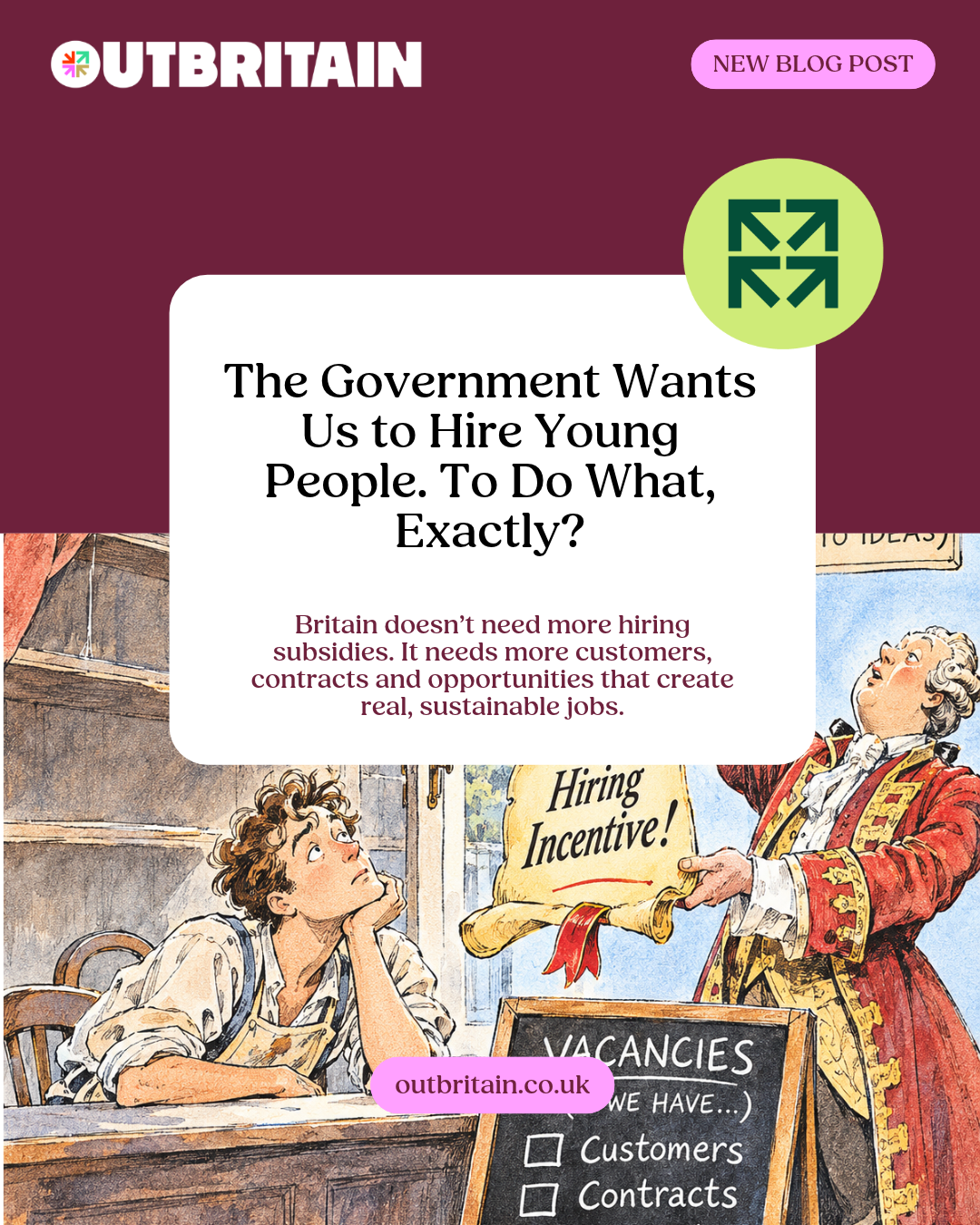
18 Nov The Government Wants Us to Hire Young People. To Do What, Exactly?
By Matt Dabrowski | Founder & CEO, OutBritain | 17 November 2026
Britain has a rather extraordinary talent for announcing solutions to problems it hasn’t quite understood.
Take youth unemployment. Nearly a million young people are neither in employment, education nor training. The Government, understandably eager to act, is offering employers incentives worth thousands of pounds to hire them.
Wonderful. Admirable, even. But I have one rather inconvenient question: hire them to do what, exactly?
Unless I’ve missed something, Westminster hasn’t delivered thousands of new customers to Britain’s small businesses. It hasn’t guaranteed new contracts, increased their revenue or made a job affordable once a subsidy expires.
Jobs are the consequence of economic activity. Not a substitute for it. A business hires because there is work to do, customers willing to pay for it and confidence that tomorrow’s revenue will cover another salary. Apparently, this is a revolutionary concept.
£8,000 sounds lovely. Until you actually run a business.
Imagine a business with five employees. Margins are tight, bills keep arriving and every expense must justify itself. Along comes the Government with a hiring incentive. Marvellous. Except the business doesn’t suddenly have another £30,000 worth of work.
Nor does a new recruit become productive overnight. An electrician needs supervised experience. A medical professional needs extensive training. Even a procurement specialist must learn contracts, commercial risk and negotiation. Somebody has to teach them—and that somebody is often the most experienced employee, now spending less time doing the work that pays the bills.
Consider a hypothetical employee aged 21 earning £25,000. Salary alone is not the full cost: employer pension contributions, National Insurance where applicable, equipment and supervision can add thousands. Reliefs and exemptions can reduce the bill, but they do not make training free.
Then there is cash flow. The much-discussed £8,000 is not a universal cheque handed to every employer. Different schemes have different eligibility and payment arrangements: the Youth Jobs Grant offers £3,000 in stages, while a separate six-month Jobs Guarantee supports eligible employment costs. Some support involves reimbursement, which matters when payroll must be met first.
And when the subsidy ends? The salary does not. The pension obligation does not. The need for customers certainly does not.
A temporary subsidy can reduce the cost of hiring. It cannot conjure the demand that makes a job sustainable.
Britain needs customers. Not another government scheme.
What, exactly, is Britain selling? We have formidable strengths in pharmaceuticals, aerospace, advanced engineering, financial services, technology and the creative industries. Yet routine services can be delivered overseas, manufacturers face fierce international competition and artificial intelligence is reshaping entry-level work.
Britain still makes remarkable things. Our challenge is converting that expertise into growing companies, export orders and contracts. We cannot always compete on price; we must compete on innovation, quality and specialisation.
A small company winning a £500,000 contract has a compelling reason to recruit. A small company offered £3,000 to hire somebody it does not need has a temporary incentive and a permanent problem. So here are three better questions for Westminster.
1. Mandate opportunity. Not another diversity report.
Britain loves a diversity target. We count representation, commission reports, appoint committees and congratulate ourselves. But how does another glossy report help a 22-year-old on Universal Credit who lacks qualifications, experience or professional connections?
Representation matters. Yet representation without economic opportunity is a limited achievement. Large employers—especially those benefiting from public contracts—should make measurable commitments to paid apprenticeships, accredited training, mentoring and progression for people facing real barriers to work.
Measure qualifications earned, retention after twelve months and whether earnings rise. Design the commitments within equality and procurement law, rather than imposing crude hiring quotas.
Diversity should not merely determine who gets a seat at the table. It should open the possibility of building the table, owning the business and employing somebody else.
2. Make big business buy from small business.
Here is an idea so obvious it might struggle to survive a government consultation: if you want small businesses to hire, help them win business.
The Procurement Act 2023 was intended, in part, to make public contracts more accessible to smaller suppliers. Good. Now let’s make that ambition tangible: accessible contract lots, fewer unnecessary barriers, stronger SME participation goals and transparent reporting on what reaches smaller suppliers.
Major corporations should also be challenged to direct a meaningful share of suitable purchasing towards capable UK SMEs, including regional and underrepresented businesses. Not contracts awarded regardless of quality, and not unlawful local preferences—genuine access and fair competition.
Imagine an engineering firm winning a substantial contract, buying equipment and recruiting two apprentices. Those jobs exist because customers exist. At OutBritain, we see what happens when entrepreneurs gain access to major buyers: one purchase order can transform a business.
A purchase order can create more lasting opportunity than a thousand promises about inclusion.
3. Dear banks, stop treating ambition as a charity case.
Britain’s banks, insurers and investment institutions support many worthwhile charities. The King’s Trust, for example, has spent decades helping young people build confidence, practical skills and pathways into employment and enterprise. It is precisely the sort of work we should build upon.
But I would challenge the financial sector to go further. Because Britain has another peculiar habit: we love the idea of ambition and can seem considerably less enthusiastic when somebody succeeds.
We urge young people to start businesses, take risks and create jobs. Then, as those businesses grow, founders face higher tax liabilities, employment costs and layers of administration. Successful businesses should contribute fairly, of course. But there is a difference between asking them to contribute and making growth feel like a penalty.
We celebrate the start-up. We seem rather suspicious of the scale-up. What lesson does that teach a young person with an idea and the courage to pursue it?
So let us ask harder questions of corporate philanthropy. How much funds recognised qualifications, paid practical training, apprenticeships and sustained employment? How much helps young founders access capital and customers? Charities need administration, and many deliver excellent outcomes—but the outcomes should be the headline, not the cheque.
Banks know how to invest today for value tomorrow. Why not underwrite industry-led training, support employers who mentor apprentices and back promising entrepreneurs with capital and commercial introductions?
Move from charity to capability. From dependency to ambition. And when people succeed, perhaps celebrate the success instead of immediately asking how much more can be taken.
Stop counting jobs. Start creating an economy worth working in.
Employment subsidies have a place. Young people facing serious barriers deserve support, and employers deserve help with the real cost of training them. But a six-month placement is not the same as a sustainable career.
We need stronger training support, better access to capital, public procurement that opens doors and financial institutions prepared to invest in people’s potential. Above all, we need more demand for what British businesses produce.
Young people deserve skills, independence and a future worth working towards. Small businesses need customers—not another form, another reimbursement to chase or another lecture about creating jobs without the work to sustain them.
So, Prime Minister, by all means encourage Britain’s businesses to hire young people.
But first, give us an economy worth hiring into.

Sorry, the comment form is closed at this time.