
24 Jul Business 101: Stop Calling It Inclusion. Start Calling It Economics.
Business 101: Stop Calling It Inclusion. Start Calling It Economics.
By Matt Dabrowski | 16 July 2026
I remember one lesson from business school that has stayed with me throughout my career.
It wasn’t a complex economic theory or a management model. It was something every first-year business student learns.
Without customers, you don’t have a business.
Simple.
Customers generate revenue. Revenue creates jobs. Jobs generate tax. Tax funds public services. Successful businesses buy from other businesses, create local employment and help communities prosper.
That’s Business 101.
Which is precisely why I find myself increasingly confused.
Not offended. Not angry. Just genuinely puzzled.
Because almost every week I walk into another boardroom and find myself explaining why LGBTQ+ businesses matter.
Not because they’re LGBTQ+.
Because they’re businesses.
Because they’re customers.
Because they’re taxpayers.
Because they’re employers.
Because they’re part of Britain’s economy.
Strip away the politics and the rainbow logos, and this should be one of the easiest commercial conversations any executive has all year.
The UK’s LGBTQ+ community is estimated to represent more than £80 billion in annual consumer spending power—what we commonly refer to as the Pink Pound. At the same time, OutBritain’s latest research estimates there are now more than 250,000 LGBTQ+-owned businesses operating across the United Kingdom. Together, they employ approximately 750,000 people and contribute more than £106 billion to the UK economy every year.
Take a moment to think about that.
If I stood in front of a board and described a sector worth £106 billion, employing three-quarters of a million people and representing an £80 billion consumer market, nobody would question whether it deserved commercial attention. There would be market analysis, customer acquisition strategies, procurement targets and investment plans.
Yet somehow, because we’re talking about LGBTQ+ businesses, the conversation often shifts away from economics and into symbolism.
That isn’t a diversity problem.
It’s a commercial blind spot.
Every LGBTQ+ entrepreneur is already somebody’s customer. Every one of us needs a bank account, insurance, accountants, solicitors, websites, payment providers, CRM software, cloud services, recruitment support, energy, broadband, vehicles, uniforms and marketing. Whether you’re a sole trader in Blackpool, a manufacturer in Swansea, a creative agency in Paisley or a technology company in London, you’re already buying products and services from Britain’s largest corporations every single day.
So whenever someone asks me why companies should support LGBTQ+ businesses, I usually respond with a question of my own.
“Who do you think is already buying from you?”
The answer is us.
We’re already investing in corporate Britain.
The real question is whether corporate Britain is prepared to invest back into the customers who generate part of its own revenue.
That’s not supplier diversity.
That’s just good business.
One of the reasons I chose to build OutBritain here is because I genuinely believe Britain remains one of the best places in the world to start and grow a business. Every year entrepreneurs come to this country because it offers something incredibly valuable: the rule of law, stable institutions, independent courts, access to finance and legal protections that allow people—including LGBTQ+ entrepreneurs—to build businesses openly.
Many founders don’t have that privilege where they come from. Around the world, people still leave countries because discrimination, religious persecution or anti-LGBTQ+ laws make entrepreneurship impossible or unsafe. Others could choose lower-tax jurisdictions that actively market themselves as business-friendly, but they also recognise that lower taxes mean very little if you can’t live authentically or safely.
Britain certainly isn’t the cheapest place to run a business. Corporation Tax isn’t low. National Insurance isn’t low. Business rates aren’t low. The cost of employing people certainly isn’t low. Entrepreneurs accept those costs because they believe Britain offers something even more valuable—stability, fairness and opportunity.
That creates a responsibility.
Legal equality should never be the destination.
It should be the foundation.
Economic opportunity is what turns equality into prosperity.
Which brings me to something I’ve never quite understood.
Every June we celebrate Pride. Companies produce incredible campaigns, sponsor events and march through our cities. Visibility matters and representation matters. I genuinely believe that.
But visibility alone doesn’t build businesses.
Pride doesn’t pay salaries.
It doesn’t pay Corporation Tax.
It doesn’t pay PAYE.
It doesn’t pay National Insurance.
It doesn’t pay suppliers.
It certainly doesn’t pay HMRC.
Customers do.
Contracts do.
Investment does.
Procurement does.
Opportunity does.
And here’s the irony I’ve never been able to get my head around. Why don’t more Pride events actively prioritise buying from LGBTQ+ businesses?
If Pride exists to celebrate our community, surely it should also be creating economic opportunity for that community.
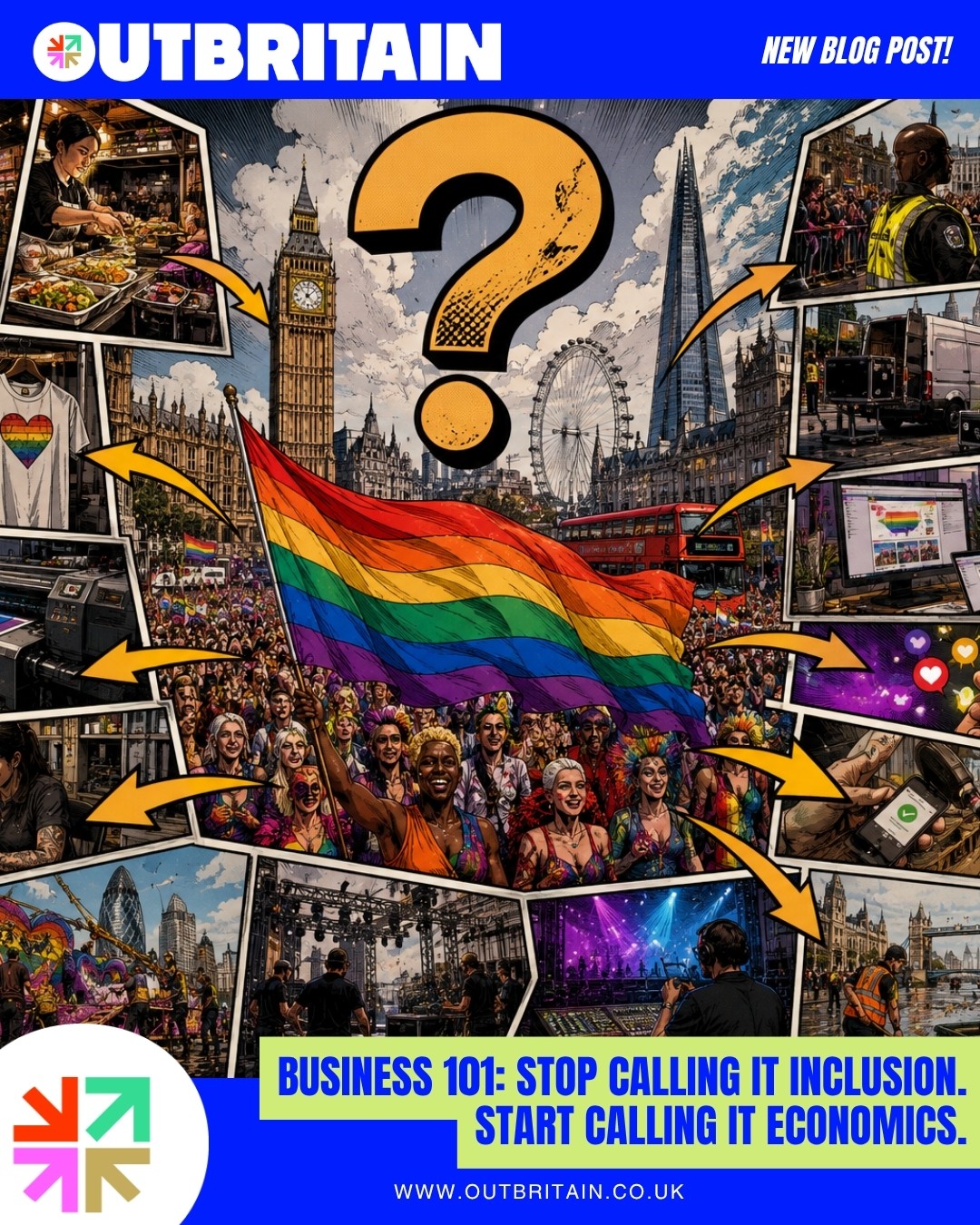
Who built the website?
Who designed the branding?
Who printed the banners?
Who supplied the merchandise?
Who provided the catering?
Who delivered the security?
Who managed the event technology?
Who produced the marketing campaign?
If those contracts are routinely leaving the LGBTQ+ business community, we’ve confused visibility with economic impact.
Community wealth isn’t created by waving flags.
It’s created when money circulates within communities, supporting entrepreneurs, creating jobs and generating prosperity that stays local.
The same principle applies to corporate Britain.
One of the greatest myths surrounding LGBTQ+ entrepreneurship is that the challenge is talent.
It isn’t.
More often than not, it’s access to capital.
The evidence is remarkable. Research from StartOut found that although around 7% of the population identifies as LGBTQ+, LGBTQ+ founders received just 0.5% of startup funding during the period it studied. Yet despite attracting significantly less investment, those same founders created 36% more jobs, produced 114% more patents and achieved 44% more successful exits than their peers.
Read that again.
Less investment.
More jobs.
More innovation.
More successful businesses.
Imagine what could happen if investment reflected potential rather than barriers.
Imagine the companies that never scale because the capital never arrives.
The jobs that are never created.
The exports that never happen.
The taxes that are never collected.
The suppliers who never win contracts.
The communities that never benefit from new employers and local investment.
That isn’t simply an equality issue.
It’s a productivity issue.
It’s an innovation issue.
It’s an economic growth issue.
What’s equally fascinating is what happens when LGBTQ+ entrepreneurs do succeed.
Research from Gusto found that 69% of LGBTQ+ entrepreneurs say making a positive impact on the communities they care about is one of the reasons they build businesses, and LGBTQ+ founders are 56% more likely than non-LGBTQ+ entrepreneurs to start a business specifically to create positive community impact.
That tells us something important.
Economic success doesn’t stop with the founder.
It ripples outwards.
Successful businesses employ local people.
They train apprentices.
They rent office space.
They pay Corporation Tax, VAT, PAYE and National Insurance.
They buy from neighbouring businesses.
They sponsor grassroots organisations.
They donate to local charities.
Large multinational corporations play an incredibly important role in our economy, but they aren’t employing six people on every struggling high street. They aren’t sponsoring every local sports club in Paisley, supporting every community initiative in Kirkcaldy, buying from independent suppliers in Blackpool or helping regenerate local economies in Swansea.
Small businesses do that.
Every single day.
Which is why this conversation has never been about charity.
We’re not asking anyone to lower standards.
We’re not asking for contracts because we’re LGBTQ+.
We’re not asking for sympathy.
We’re asking for markets to work properly.
If an LGBTQ+ supplier offers the best service, buy from them.
If an LGBTQ+ founder has the strongest investment proposition, invest in them.
If an LGBTQ+ entrepreneur builds an exceptional business, open the door.
That’s not diversity.
That’s competition.
That’s capitalism working exactly as it’s supposed to.
There’s one final point I’d leave every executive with.
LGBTQ+ consumers are not naïve.
Like every consumer, they notice who consistently invests in the communities they serve, and they notice when that commitment quietly disappears once the rainbow flags come down. Trust is one of the most valuable assets any brand owns. Companies spend millions building it, yet it can be eroded remarkably quickly when customers feel that inclusion is seasonal rather than strategic.
This isn’t about encouraging boycotts or demanding perfection. It’s about recognising that authenticity has commercial value.
People naturally gravitate towards businesses they believe genuinely value them, and over time they drift away from those that don’t.
That’s not activism. That’s consumer behaviour.
For years we’ve measured success by the number of rainbow flags in shop windows.
I think we’ve been measuring the wrong thing.
I’d rather know how many LGBTQ+ businesses won contracts this year.
How much investment reached LGBTQ+ founders.
How many new jobs were created.
How much tax was generated.
How much wealth stayed in communities like Paisley, Blackpool, Kirkcaldy or Swansea.
Because that’s how economies grow.
And if we genuinely believe in equality, then surely our ambition shouldn’t be to celebrate LGBTQ+ businesses once a year.
It should be to make them impossible to ignore for the other 364 days.
Perhaps then we could finally stop asking whether LGBTQ+ businesses matter and start asking a much better question:
How much stronger would Britain’s economy be if we fully backed one of its most entrepreneurial, resilient and economically valuable business communities?
Because this has never really been about diversity.
It’s always been about economics.
And economics doesn’t take a month off.

Sorry, the comment form is closed at this time.