
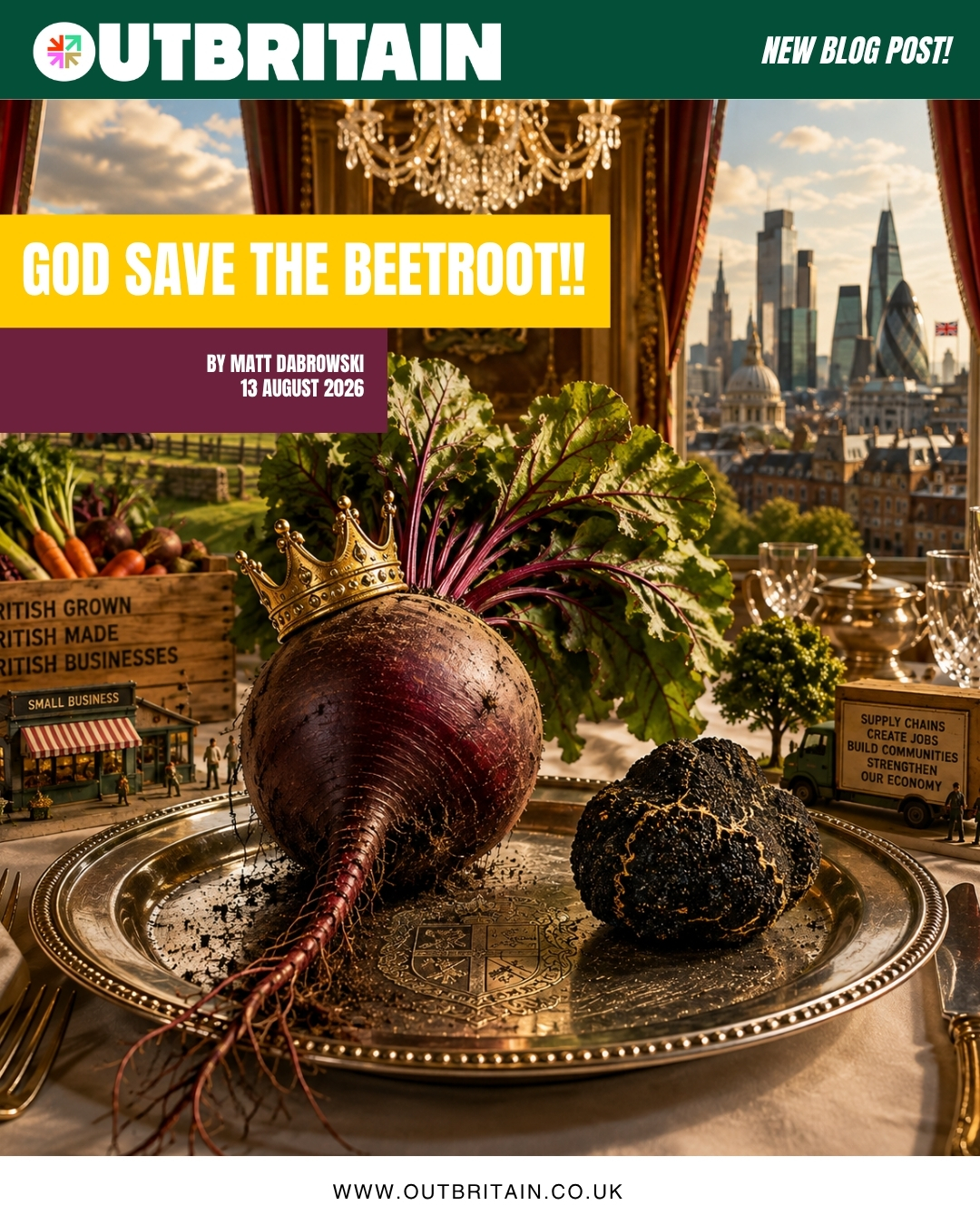
14 Aug God Save the Beetroot
God Save the Beetroot
By Matt Dabrowski
13 August 2026
What King Charles, British provenance and one rather divisive root vegetable can teach us about who gets the chance to grow.
I have been thinking about beetroot, which is not a sentence I expected to write.
I run an organisation supporting LGBTQ+ businesses, so my days tend to involve procurement, economic inclusion, government policy, corporate partnerships and the occasional existential conversation about supplier diversity. Vegetables do not normally feature prominently. And yet, increasingly, I find myself thinking about them — or, more specifically, about King Charles’s vegetables.
The King has spent much of his adult life being unusually interested in where things come from: food, wool, timber, buildings, crafts and even hedgerows, which have received a level of royal attention most of us reserve for close relatives. Long before sustainability departments, ESG reports and corporate net-zero strategies became fashionable, Charles was talking about soil. Actual soil. He converted land at Highgrove to organic farming in the 1980s, when plenty of people still considered the idea eccentric, and later created Duchy Originals.
It began rather modestly with an oat biscuit, but the idea behind it was considerably more ambitious than creating something respectable to have with tea. Charles wanted to demonstrate that commercial success could support farmers, protect the environment, preserve traditional skills and generate money for good causes at the same time. He described it as a “virtuous circle.” Today, we might call it sustainable economic development, community wealth building or responsible capitalism. Charles, rather sensibly, put it in a biscuit.
Underneath the organic flour and royal warrants sits a remarkably modern economic proposition: where money goes matters.
The royal obsession with where things come from
Royal hospitality offers a particularly wonderful glimpse into this philosophy. When Buckingham Palace hosted a dinner in February 2025 ahead of the King and Queen’s state visit to Italy, the food was Italian. Sort of. There was Scottish crab, Yorkshire pecorino, Isle of Wight tomatoes, Suffolk pork and herbs from Highgrove. Chef Francesco Mazzei described the menu as being made with 99% British produce. The olive oil, mercifully, remained Italian. Even the monarchy has limits.
The point was not that Britain had suddenly discovered tomatoes superior to the Italians. It was provenance. Here was a dinner celebrating another country while quietly saying something rather confident about our own: look what we grow; look who produces it; look at the places behind it.
The same instinct appears repeatedly in royal hospitality. At the 2025 State Banquet for President Donald Trump, the menu included organic Norfolk chicken, Hampshire watercress, Kentish raspberry sorbet and Victoria plums. Not merely chicken, but Norfolk chicken. Not simply raspberries, but Kentish raspberries. Those adjectives are doing economic work. They tell us that the ingredient came from somewhere, that somebody produced it, and that somewhere in Britain benefited from its selection.
An ingredient, in other words, acquires an economic biography.
Britain has become rather good at this. We do not merely eat cheese anymore; we eat cheese made by somebody called Tom on the side of a hill in Somerset whose cows, judging by the packaging, appear to have a better work-life balance than most of London. We buy Kentish apples and small-batch Highland gin made with a botanical that can apparently only be harvested during a full moon. And we love it because provenance transforms an ordinary transaction into something larger. You are not merely buying the carrot. You are supporting the farm, preserving a skill, sustaining a producer and keeping money circulating somewhere.
Which brings us, somewhat unexpectedly, to beetroot.
God save the beetroot
Beetroot has a slight public-relations problem. Not everyone actually likes it. It is hardly the Beyoncé of the vegetable aisle. It is earthy, stains everything it touches and has an alarming tendency to turn an otherwise respectable dinner plate the colour of a minor medical emergency. For something that spends most of its life underground, it possesses an extraordinary ability to demand attention.
And yet there it is, appearing on restaurant menus and at important dinners, presented beautifully, perhaps beside goat’s cheese, possibly with a walnut and almost certainly accompanied by something described as a reduction. Nobody has guaranteed that you are going to like it. Someone has simply decided that it deserves the chance to be there.
This is where my vegetable problem became a business problem.
Because if Britain understands the value of giving the beetroot a chance, why are we so reluctant to do the same for businesses?
The easy version of this argument would be that British producers need protecting from cheap imports. But that is not really what interests me, because sometimes the competition is considerably more glamorous: the imported ingredient, the rare ingredient, the expensive ingredient, something with a French name, an Italian grandmother and the sort of pedigree that looks considerably more at home printed in gold on a state dinner menu.
The truffle.
And yet we still deliberately make room for something grown here. Why? Because choosing British is not always about price, nor is it necessarily about luxury. It is about deciding that provenance itself has value. The farmer matters. The place matters. The skills matter. The ecosystem surrounding that producer matters.
This does not mean banning the truffle. I would like to be very clear about that. Sometimes you need a truffle. But sometimes we become so accustomed to ordering truffles that nobody has bothered to look at what else is growing.
Procurement has much the same problem.
The corporate truffle
Underrepresented businesses are not simply competing against cheaper alternatives. More often, they are competing against something considerably more powerful: familiarity.
There is the global consultancy, the famous advertising agency, the incumbent technology provider and the supplier that has been on the framework for so long that nobody can quite remember who originally appointed them. They arrive with 400 case studies, twelve offices and a logo everybody in the meeting recognises. They are the corporate equivalent of the truffle, and nobody gets fired for buying the truffle.
The LGBTQ+ entrepreneur, meanwhile, may be sitting quietly at the other end of the shelf. Perhaps their business is capable and innovative. Perhaps it is better. Perhaps it is worse. We do not actually know, because nobody has tasted the beetroot.
This is where I think we have sometimes made the wrong argument about LGBTQ+ business inclusion. For years, the proposition has too often sounded like: this company is LGBTQ+ owned, therefore you should support it. I do not think that is enough. Being LGBTQ+ does not make you a good accountant or a brilliant engineer. Being bisexual does not, despite what some Pride campaigns occasionally seem to imply, give you supernatural abilities in graphic design.
The beetroot still has to taste good.
A business must be competitive. It must deliver, solve a problem and create value. Identity is not a substitute for capability. But there is another side to that argument that receives considerably less attention: familiarity is not a substitute for quality either.
We’re not asking you to buy the beetroot
We are asking you to put it on the shelf.
Give the business visibility and access. Allow it onto the pitch list. Let it participate in the tender. Introduce it to the buyer and give it the opportunity to demonstrate what it can do. Then let the market decide. If it is terrible, do not buy it. If it is brilliant, buy more.
This should not be particularly radical. It is capitalism, with slightly better shelf management.
The problem facing many underrepresented businesses is not necessarily that they cannot compete; it is that competition often begins before they arrive. The same suppliers are invited to tender, the same agencies appear on pitch lists and the same professional networks make the introductions. Those businesses win contracts, which create case studies, which help them win larger contracts, which strengthen their balance sheets, which qualify them for bigger frameworks, which generate still more contracts.
Economists might call this cumulative advantage. Most entrepreneurs would simply call it knowing the right people.
Eventually, we look at our supply chains and wonder why everybody looks remarkably similar. The answer may be less mysterious than we imagine. The beetroot never made it to the shelf.
The strange thing is that Britain already understands this
We understand the principle perfectly when food is involved. We tell consumers where something came from, put the farmer’s photograph on the packaging, celebrate the county, create farmers’ markets, protect traditional skills and build routes to market for smaller producers. None of this requires us to abandon standards. Nobody argues that a British farmer should be allowed to sell terrible strawberries simply because they happen to have been grown in Kent. The strawberry still has to be good. What we recognise is that without access to the shelf, the farmer never gets the opportunity to prove it.
So why does our curiosity about provenance disappear when we begin buying professional services?
A corporation might know precisely where the coffee in its headquarters was grown. It may know whether the cotton in its uniforms was sustainably sourced, calculate the carbon embedded in its electricity and proudly tell customers that the chicken in its sandwich came from Norfolk and lived, one assumes, a deeply fulfilling life. Then the same corporation can spend £100 million through its supply chain while knowing remarkably little about the economic provenance of that money.
Who owns those businesses? Where are they based? Who do they employ? Who do they buy from? What happens when they grow? Where does the wealth ultimately circulate?
Apparently, we are intensely curious about the provenance of lunch and rather less curious about the provenance of £100 million.
That strikes me as odd.
From identity to economic impact
At OutBritain, we work with LGBTQ+ businesses. But increasingly, I do not think our job should simply be counting how many LGBTQ+ suppliers exist. Counting is easy. The more interesting question is what happens when those businesses actually receive an opportunity.
Businesses create ecosystems too. Give an entrepreneur a meaningful contract and they might hire someone. That employee spends a salary. The company needs an accountant, buys software, commissions a designer, rents an office or takes on an apprentice. The founder may mentor another entrepreneur, support a local charity or buy from another British SME. Eventually, perhaps, they invest in somebody else’s business.
One procurement decision begins to travel.
Money has a rather wonderful habit of doing that. Capital circulates, businesses grow and economic activity creates further economic activity. That is community wealth building. No rainbow lanyard required.
This changes the question we should be asking. Rather than stopping at “How many diverse suppliers do you have?”, we should ask: “What happened because you bought from them?”
Did somebody get hired? Was an apprenticeship created? Did another British SME win work? Did the company expand, export or invest? Did the founder mentor somebody? Did wealth find its way into a community organisation? Did that company become large enough that next time it no longer needs an organisation like OutBritain to make the introduction?
Imagine being able to demonstrate that £1 million of corporate spending with underrepresented British businesses generated jobs, local purchasing, charitable contributions, exports, innovation and further entrepreneurship. At that point, we are no longer talking about a Pride initiative.
We are talking about economic infrastructure.
From identity to impact
This, to me, is where supplier inclusion needs to go next. For years, supplier diversity has been understandably preoccupied with identifying who owns a company. That matters, because without measurement it is very difficult to know who is participating in an economy and who is not. But identity should be the beginning of the analysis rather than its conclusion.
The more interesting question is what happens because that company grows.
Charles’s “virtuous circle” offers a surprisingly useful framework. Farmers produce. Businesses buy. Consumers spend. People are employed. Profits are generated. Money is reinvested and communities become stronger. The King’s version happens to contain biscuits. Ours contains businesses. Economically, the principle is not particularly different.
And this is why we need to stop confusing opportunity with charity.
Underrepresented businesses do not need pity. They need markets. The farmer does not want you to applaud the carrot. He wants you to buy the bloody carrot. And if it is not good enough, do not buy it again. That is how markets work.
But first, it has to reach the shelf.
That, I believe, is what organisations such as OutBritain should increasingly be trying to solve. Not how do we persuade companies to be nicer to LGBTQ+ people? but how do we ensure excellent businesses that have historically been less visible have a genuine opportunity to participate in the British economy — and how do we prove what happens when they do?
That is a much more interesting proposition. It is also considerably more demanding, because it requires corporations and governments to move beyond statements of intent and examine where their money actually goes. The question ceases to be simply did we include someone? and becomes what did our spending make possible?
That is not charity. It is not lowering the bar, and it is certainly not a Pride campaign dressed up as procurement.
It is market development. Done properly, it is economic policy.
Perhaps British pride needs an update
There is something else I rather admire about Charles’s philosophy: it is possible to celebrate what Britain produces without pretending the rest of the world does not exist. British ingredients can make Italian food. A Scottish company can become an international exporter. A traditional craft can adopt modern technology. Local and global are not opposites, just as tradition and innovation are not opposites.
Supporting homegrown businesses does not mean closing Britain off from the world. Quite the opposite. It means creating more British companies capable of competing in it.
And surely that ambition should include entrepreneurs who have not historically resembled the people we picture when someone says British business leader.
The next great British technology company might be founded by a lesbian in Leeds. The next manufacturing innovation might come from a disabled entrepreneur in Birmingham. The next brilliant creative agency might be owned by two gay men in Cardiff. The next British export success might currently consist of three people sitting above a coffee shop in Glasgow.
Perhaps none of them will succeed. Perhaps all of them will.
We do not know. That is rather the point.
They need the opportunity to grow before any of us can discover what they might become.
So, God save the beetroot
God save the slightly muddy, occasionally unpopular, alarmingly purple British beetroot. And the family farm, the peculiar British cheese, the craftsperson, the manufacturer, the independent shop and, yes, the LGBTQ+ entrepreneur.
Let the beetroot sit beside the truffle. Tell us where it came from. Put it on the shelf, the menu and the plate, and allow it to compete. We do not have to like it. We certainly do not have to buy it twice.
Just give the bloody thing a chance.
Perhaps we might extend the same courtesy to Britain’s underrepresented entrepreneurs. Not a guaranteed contract, a lower standard or corporate charity dressed up as procurement. Simply a shelf. A menu. A seat at the table. An opportunity to prove that they are good.
Because British pride should not only be about preserving the things Britain has already produced. It should also be about deciding what Britain gets the chance to grow next.
King Charles has spent decades arguing that ecosystems matter, that provenance matters and that the choices we make as consumers can determine which farms, skills, communities and traditions survive. Perhaps procurement could borrow a little of that thinking.
Ask where your suppliers come from. Ask who owns them and where the money goes. Ask what grows because you chose them.
And then choose the best.
Because sometimes the difference between something flourishing and disappearing is not another policy, another pledge or another beautifully designed corporate commitment. Sometimes somebody simply decided that it deserved a place on the shelf.
If we can give the beetroot that chance, surely we can give a British business one.

Sorry, the comment form is closed at this time.