
27 Jan Why Supporting LGBTQ+ Businesses Is Social Impact
Why Supporting LGBTQ+ Businesses Is Social Impact
By Matt Dabrowski, Founder & CEO, OutBritain
I was recently asked a question that genuinely stopped me in my tracks:
“Why does supporting LGBTQ+ businesses count as social impact? Government doesn’t define it that way.”
And that right there is the problem.
Because when you look at the lived reality of LGBTQ+ people in the UK, it becomes painfully clear that economic inclusion isn’t separate from social impact — it is social impact.
Here’s the reality many people still don’t see:
-
-
- 1 in 4 LGBTQ+ young people face hidden homelessness — compared to around 4% of the general population. For trans young people, it’s closer to 1 in 3.
- LGB+ people in the UK are over twice as likely to die by suicide as straight people.
- 4 in 10 LGBTQ+ employees still feel unsafe being themselves at work, and 1 in 4 face verbal abuse from customers.
- Almost half (47%) of LGBTQ+ workers experience discrimination at work.
- 18% of LGBT people looking for work experience discrimination while job-seeking.
- In just one year, police recorded 18,702 anti-LGBTQ+ hate crimes and 3,809 anti-trans hate crimes in England and Wales.
- At school, over half of LGBT pupils are bullied, nearly three-quarters of trans young people are bullied, and 41% of trans young people have tried to take their own life.
-
This isn’t just a human-rights crisis.
It’s an economic exclusion crisis.
It’s an economic exclusion crisis.
When people are bullied at school, pushed out of family homes, discriminated against at work, abused by customers, locked out of jobs, and targeted by hate crime — their chances of building stable careers, businesses, and financial security collapse.
So what happens?
People turn to entrepreneurship out of necessity, not choice.
They start businesses because the labour market failed them.
They build their own safety nets because society didn’t provide one.
They start businesses because the labour market failed them.
They build their own safety nets because society didn’t provide one.
That’s where LGBTQ+ businesses come in — and why supporting them is direct social impact.
When you invest in an LGBTQ+ founder, you are not just backing a company.
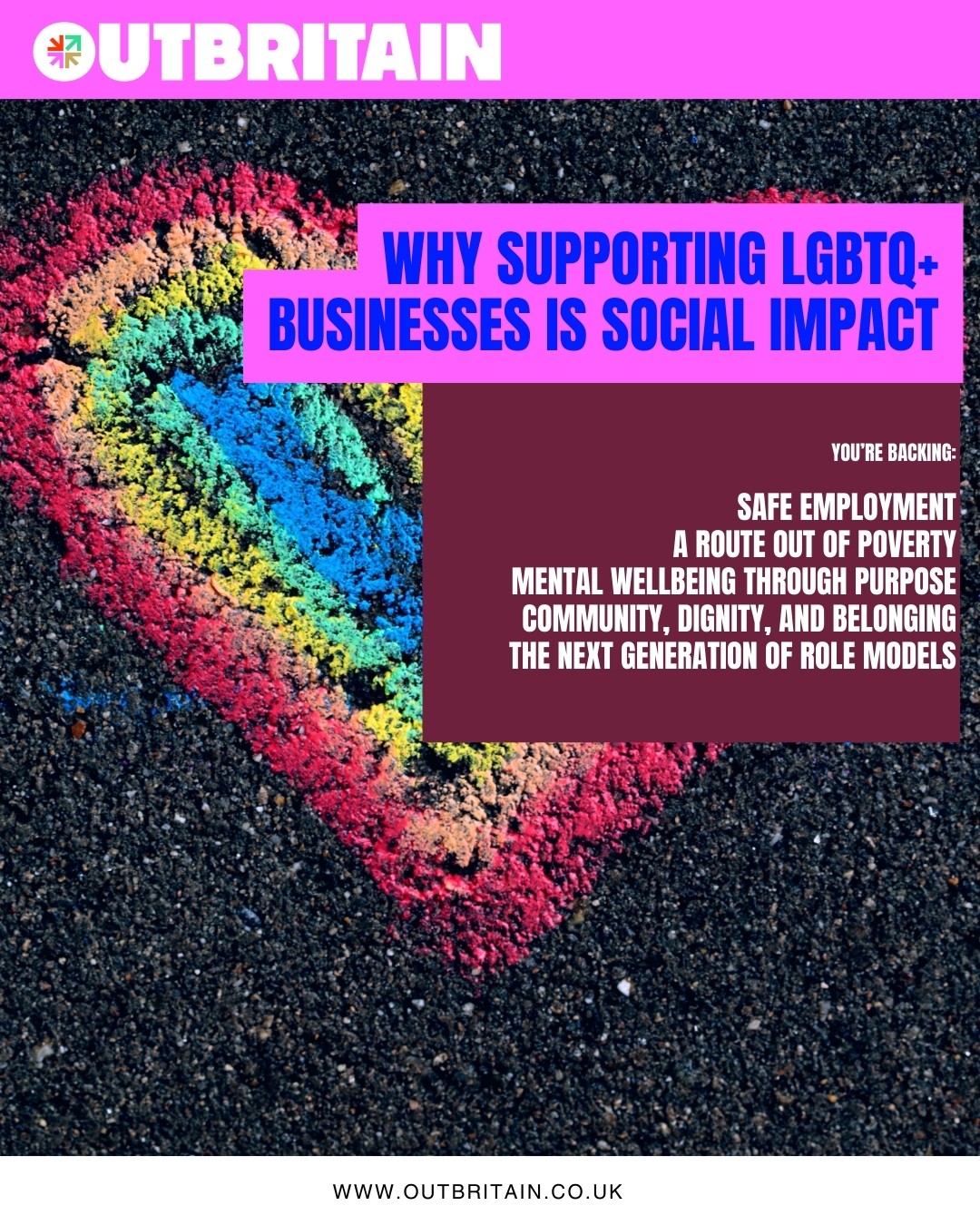
You are backing:
You are backing:
-
-
- A safe employer for people excluded elsewhere
- A route out of homelessness, poverty, and dependency
- A mental-health protective factor through purpose, income, and dignity
- A community hub where people can be seen, supported, and valued
- A role model for the next generation who needs proof that survival can become success
-
This is what government definitions of “social impact” fail to capture.
They measure outputs.
We measure outcomes.
We measure outcomes.
At OutBritain, we see this every single day.
LGBTQ+ founders hiring LGBTQ+ staff who were previously unemployed.
Businesses keeping people housed.
Founders mentoring young people who were thrown out of home.
Communities forming around economic dignity, not just identity.
Businesses keeping people housed.
Founders mentoring young people who were thrown out of home.
Communities forming around economic dignity, not just identity.
But here’s the uncomfortable truth:
The LGBTQ+ business community is doing all of this without proportional investment, visibility, procurement access, or institutional support.
Imagine what could change if:
-
- LGBTQ+ businesses had fair access to corporate and public-sector contracts
- Supplier diversity included LGBTQ+ people as standard
- Investment funds recognised LGBTQ+ founders as an impact asset class
- Governments treated economic inclusion as prevention, not charity
We don’t need sympathy.
We need opportunity.
We need opportunity.
Because when LGBTQ+ people are economically secure, everything improves:
-
- Mental health stabilises
- Homelessness drops
- Suicide risk falls
- Dependency on public services reduces
- Community resilience grows
- The next generation sees a future worth staying for
So yes — supporting LGBTQ+ businesses is social impact.
It just happens to be the kind that creates jobs, pays taxes, reduces inequality, and builds long-term economic resilience instead of short-term fixes.
That’s not a niche issue.
That’s smart policy.
That’s smart procurement.
That’s smart investment.
That’s smart policy.
That’s smart procurement.
That’s smart investment.
And it’s long overdue.

Sorry, the comment form is closed at this time.