
02 Dec If Your Supply Chain Isn’t Diverse, Neither Is Your Impact.
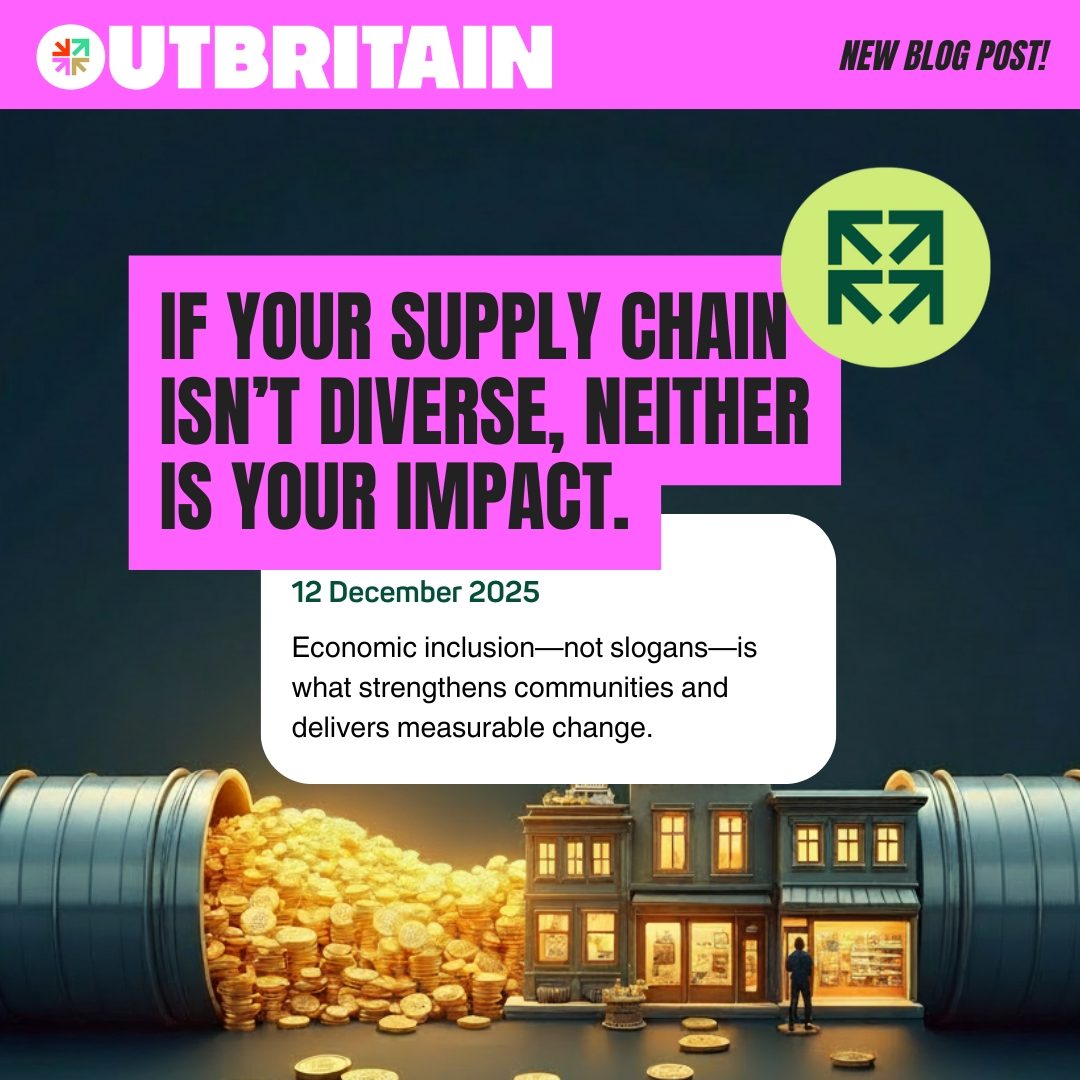
If Your Supply Chain Isn’t Diverse, Neither Is Your Impact.
Economic inclusion—not slogans—is what strengthens communities and delivers measurable change.
By Matt Dabrowski, Founder & CEO, OutBritain
Corporate leaders speak often about social impact, but we rarely talk about the one lever that can actually deliver it at scale: who we buy from.
For years, social impact has focused on carbon reduction, charity fundraising, or community volunteering. All important, all valuable. But none of it replaces the systemic power of economic opportunity. In a political moment where some are calling to roll back diversity, equality, and inclusion altogether, the ability of businesses to create meaningful, measurable impact through procurement has never mattered more.
Inclusive procurement is not an add-on.
It is the missing pillar of social value.
The Missing Dimension in Social Impact
Traditional social impact frameworks don’t ask the most basic question: Who is benefiting from your economic activity?
And more importantly: Who isn’t?
For LGBTQ+ entrepreneurs — a sector with enormous potential — the answer is stark. Despite their contribution to the UK economy, they remain almost invisible within supply chains. Most procurement strategies still overlook them entirely.
This is a loss not only for LGBTQ+ business owners, but for the organisations that miss out on the innovation, resilience, and cultural intelligence that diverse suppliers bring.
Integrating supplier diversity into social impact strategy is not only the right thing to do — it builds stronger outcomes across every part of the value chain.
The Economic Contribution of LGBTQ+ Businesses
OutBritain’s LGBTQ+ Businesses Count report — the first national dataset of its kind — reveals the true scale of LGBTQ+ entrepreneurship:
- LGBTQ+ businesses contribute over £106 billion to UK GDP.
- They employ more than 750,000 people, across every major sector.
And critically:
- More than half of LGBTQ+ businesses report that 57%+ of their workforce identifies as LGBTQ+.
This means LGBTQ+ entrepreneurs are not just creating jobs — they are creating inclusive employment ecosystems: workplaces where safety, authenticity, and belonging are not policies but realities.
Inclusive businesses create inclusive economies.
These companies also reinvest at higher rates. They support charities, run youth programmes, fund cultural initiatives, and lead community advocacy. Their success doesn’t sit in a profit column — it circulates.
We see this ripple effect clearly:
- The Elton John AIDS Foundation has mobilised over US $650 million globally to support LGBTQ+ communities, young people, and those affected by HIV and AIDS, funding life-saving healthcare and prevention programmes across dozens of countries.
- The Terrence Higgins Trust, supported by community fundraising and contributions from organisations across the UK, continues to deliver HIV testing, counselling, and sexual-health services nationwide.
- Stonewall, backed by more than 650 corporate partners, drives workplace equality, anti-bullying programmes, and policy change — all strengthened by the businesses that invest in its mission.
The pattern is unmistakable:
When LGBTQ+ businesses have equitable access to opportunity, the entire community benefits.
Economic inclusion becomes social inclusion.
Why Inclusive Procurement Delivers Real Social Impact
Buying from LGBTQ+ suppliers delivers outcomes that no amount of messaging can replicate.
- Job Creation & Economic Mobility
Supplier diversity directly creates jobs in communities that face higher barriers to employment and progression. When spend reaches LGBTQ+ businesses, it fuels fair wages, stable work, and upward mobility.
- Innovation & Competitiveness
Research from McKinsey, Harvard, and the World Economic Forum shows that diverse suppliers outperform on innovation, agility, and problem-solving.
And the past five years have proven this point again and again.
Covid-19, Brexit, new trade barriers, supply shortages, and the cost-of-living crisis all exposed the vulnerabilities of traditional supply chains. The organisations that fared best were those with diverse, decentralised, resilient supplier networks. Diversity isn’t a moral preference — it’s a strategic one.
- Community Reinvestment
LGBTQ+ founders give back at higher rates, creating a multiplier effect on every pound spent. Procurement becomes a tool for strengthening the social infrastructure many communities rely on.
- Alignment with Public Policy
The UK Procurement Act 2023 prioritises fairness, transparency, and social value — positioning inclusive procurement as both an advantage and a compliance enabler.
Inclusive procurement drives value that can be measured, audited, and defended.
The Political Context — and a Call for Leadership
Across the UK and globally, diversity and inclusion are under attack. Some political groups openly call for DEI efforts to be dismantled from government altogether.
In such a climate, economic inclusion becomes one of the most durable forms of protection.
Procurement spend cannot be “announced away.”
It cannot be removed with a speech or a headline.
When LGBTQ+ businesses are embedded in supply chains, they become stronger, safer, more visible — and far less vulnerable to political volatility.
This is the moment for real leadership. Not performative commitments, but structural ones. Not statements, but spend.
How OutBritain Supports This Work:
As the UK’s first LGBTQ+ Chamber of Commerce and certifying body, OutBritain is at the forefront of inclusive economic development. We provide:
- Verified LGBTQ+ business certification
- The largest LGBTQ+ supplier network in the UK and Europe
- Supplier development and scale-readiness programmes
- Procurement training for corporate partners
- Annual social impact reporting
- International links with partners in the US and Canada
Our mission is simple:
To make inclusive procurement standard practice, driving the economic empowerment that strengthens our communities and our country.
A Call to Action
If social impact is to mean anything, it must include economic opportunity.
Procurement is one of the most direct, measurable, and powerful tools to achieve it.
By choosing to work with LGBTQ+ suppliers, organisations strengthen supply chains, drive innovation, uplift communities, and contribute to a fairer, more resilient economy.
This is not just good business.
It is the future of British business.

Sorry, the comment form is closed at this time.